Location: Cañada de
Gómez Industrial Park, Santa Fe Province.
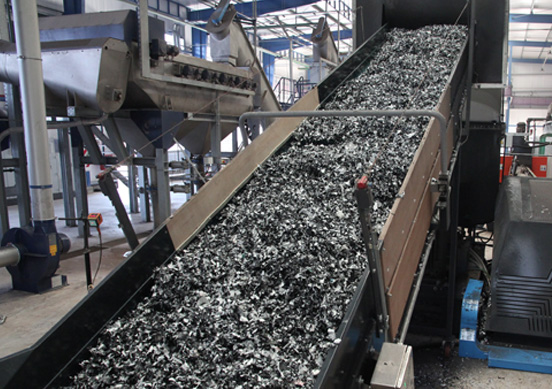
The object of this undertaking is the recovery of plastic waste from the
field, in a volume equivalent to that generated by ACA from the production
and marketing of silos bags and plant protection products, thus extending
the life cycle of plastics through their transformation into a new raw
material for various industrial uses.
55,000 tons of plastic waste
are generated annually In Argentina from silos bags and containers of plant
protection products. Our plant has a capacity to process 7000 tons of
plastic per year.
Learn more about the Recovery Plant, click here..
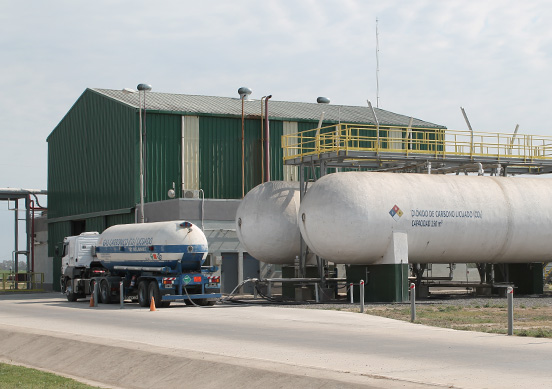
Through this plant, 63,907 tons of food grade CO2 have been recovered at
ACABIO, which is equivalent to 37,592,353 Nm3 of natural gas that has been
avoided to combust.
This volume of natural gas saved is in turn equivalent to what ACA BIO
consumes in 396 days of ethanol and co-product production at maximum
installed capacity.
Location: Juan Llerena,
Province of San Luis.
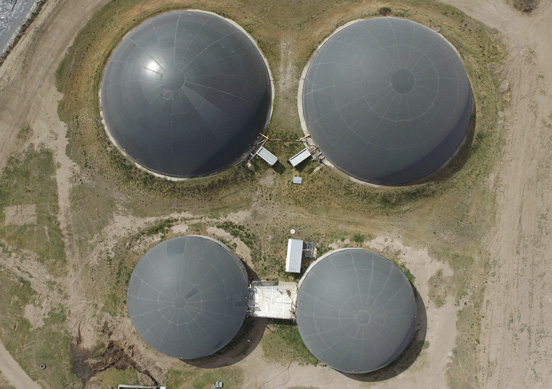
In an annex to the Yanquetruz pig farm we created a Power Co-Generation
Plant made up of four biodigesters that use the stool of the animals which,
in combination with other raw materials such as sorghum and corn, produce
biogas.
The generation of electric power and heat energy originated from biomass,
allows the self-sufficiency of the farm and the irrigation systems, in
addition to which it could provide the electric power equivalent to that
consumed by ACA´s Puerto San Lorenzo. Through this undertaking we contribute
to the diversification of the energy matrix.
Bio Energía Yanquetruz SA, is the company through which we provide electric
power to the national interconnected system.
Location:
Justiano Posse, Province of Buenos Aires.
This unprecedented plant in Argentina was installed and started in our Lean
Food Cold Storage Plant, located in Justiniano Posse, province of
Córdoba. According to design, based on by-products of the meat industry of
low economic value, it produces electric power and heat energy, in both hot
and cold formats.
This operation allows to generate energy without greenhouse effect gas
emissions and to reduce non-renewable energy consumption. Since its
commissioning, the plant generates absorption cooling, saving the electric
power required by the refrigerant gas compressors for the cold-storage
rooms.
The operation of the bio-digestion and electricity generation sector was
interrupted in order to modify it, so that it can receive other additional
substrates that improve the bio-digesters´ diet, making it more stable. Said
modification is in the process of progress